In 2026, the National Medical Products Administration issued Guo Yao Jian Zong [2026] No. 6, namely the Implementation Opinions on "AI + Drug Regulation". The document explicitly proposed comprehensively advancing the construction of high-quality datasets for drug regulation. It called for deepening the smart drug inspection construction initiative, advancing the construction of an integrated, digital-intelligent inspection system, improving inspection efficiency, accuracy, and the ability to identify risk signals, and encouraging exploration of the application of robotics technology in inspection.
The policy explicitly proposed deploying risk monitoring agents based on enterprises' real-time analysis results of data such as production process monitoring videos, images, and IoT sensing, advancing smart drug inspection construction, and achieving dynamic identification of quality risks throughout the entire production process and full-chain traceability. This means that the traditional drug appearance quality control model relying on manual visual inspection can no longer match the new standards of digital-intelligent regulation: problems such as fluctuating missed detection rates, difficulty in accumulating inspection data, inability to connect with regulatory traceability systems, and insufficient control intensity for high-risk varieties are forcing pharmaceutical companies to accelerate the iterative upgrading of visual inspection equipment.
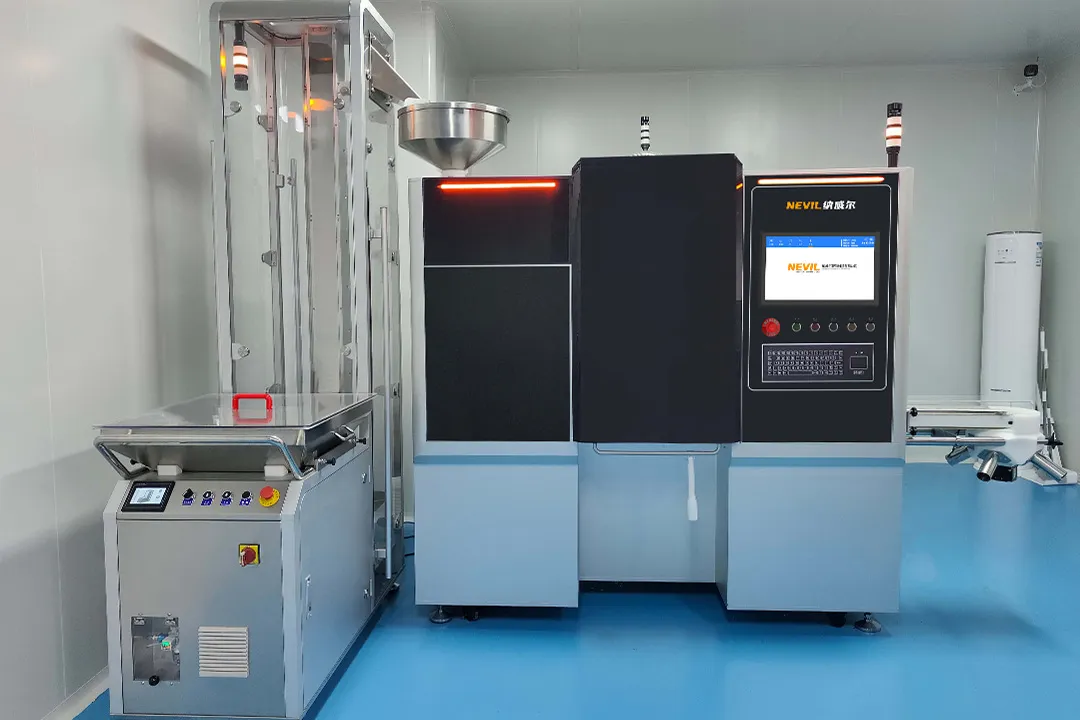
As a leading enterprise in the field of pharmaceutical inspection equipment, the 360° tablet, soft capsule, and hard capsule appearance inspection machines launched by Naweier are precisely a practical solution that addresses industry challenges and aligns with policy guidance. To address the pain points of appearance inspection for large and small particle sizes and different dosage forms, this series of equipment adopts a 360° comprehensive visual imaging solution, breaking the field-of-view limitations of traditional single-side inspection and comprehensively identifying dozens of appearance defects such as cracks, chipped corners, spots, color differences, scratches, and unclear printing.
Equipped with AI vision algorithms trained specifically for pharmaceutical scenarios, the equipment's inspection accuracy and stability far exceed manual visual inspection. It can still maintain accurate inspection precision and speed under high-speed operation, fully meeting the strict quality control requirements for high-risk varieties, corresponding to the construction direction in the policy of "improving inspection efficiency, accuracy, and risk signal identification capability".
More importantly, the equipment does not merely perform the single function of "quality rejection"; instead, it can output standardized inspection images, defect classification data, and batch traceability records, and can seamlessly connect with pharmaceutical companies' production MES systems and drug traceability systems. This corresponds to the regulatory requirements in the policy for "real-time analysis of production process data and full-chain traceability", providing complete data support for enterprise quality control and regulatory data reporting, and truly realizing "inspection leaves traces, defects are traceable, and risks can be predicted".
At the same time, the equipment follows the human-machine collaboration logic of "digital-intelligent empowerment and manual review", supports review of defect samples and flexible adjustment of inspection parameters, giving play to the efficiency of AI while retaining the final judgment right of humans, which is highly consistent with the AI-assisted positioning clarified in the policy.
As the "AI + Drug Regulation" policy advances in depth, the digital-intelligent transformation of drug production and inspection has changed from an industry option to a mandatory compliance question. With the 360° tablet, soft capsule, and hard capsule appearance inspection machines as its core matrix, Naweier further covers full-category inspection equipment such as integrated capsule weighing and appearance inspection machines, capsule appearance inspection machines, capsule checkweighers, fully automatic blister pack inspection machines, aluminum foil sealing quality inspection machines, and inkjet/embossed character inspection machines, extending AI vision capabilities across the entire production chain of dosage form inspection, weight verification, packaging quality control, and label verification, comprehensively anchoring pharmaceutical quality checkpoints and safeguarding peace of mind in medication use; with the power of digital intelligence, it supports the industry's high-quality future.
 Scan for more



