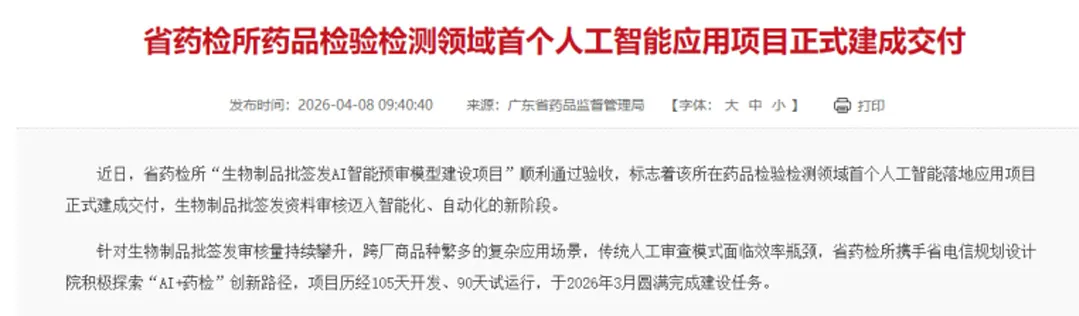
In March 2026, the "AI Intelligent Pre-review Model Construction Project for Batch Release of Biological Products" of the Guangdong Institute for Drug Control passed acceptance. As the first artificial intelligence implementation project in the field of drug inspection and testing, its trial operation data delivered an impressive report card: the average accuracy of AI pre-review reached 98% (higher than the design standard of 90%), the issuance time of a single review report was compressed to within 10 minutes, labor costs were saved by more than 60%, and it operated continuously 7×24 hours.
> The regulatory side has already used AI to pull review efficiency to a new order of magnitude. Can pharmaceutical companies on the production side continue to rely on manual visual inspection?
I. Authoritative Benchmark: What the Guangdong Institute for Drug Control Has Validated
The Guangdong Institute for Drug Control, together with the Guangdong Telecommunications Planning and Design Institute, spent 105 days on development and 90 days on trial operation, and completed project construction in March 2026. With large language models (LLM) and OCR technology as the core, the platform covers the entire process from document parsing → indicator extraction → logical reasoning → compliance judgment → report generation, and realizes intelligent pre-review for 7 pilot biological product varieties (human albumin, human coagulation factor VIII, intravenous human immunoglobulin, hepatitis B vaccine, etc.) that account for 60% of business volume.
| Dimension | Quantified Results |
| Construction period | 105 days development + 90 days trial operation |
| Delivery time | Passed acceptance in March 2026 |
| Coverage | 7 pilot biological product varieties (human albumin, human coagulation factor VIII, intravenous human immunoglobulin, hepatitis B vaccine, etc.) |
| Review accuracy | 98% (higher than the design standard of 90%) |
| Time per report | Compressed to within 10 minutes |
| Labor cost | Saved more than 60% |
| Operating mode | 7×24 hours uninterrupted |
Data source: Guangdong Medical Products Administration official WeChat account and related industry reports
The platform has formed a closed-loop mechanism of "AI intelligent preliminary review + expert manual re-review + full-process traceability with retained records" — this is precisely the key paradigm through which "AI + drug inspection" has achieved large-scale implementation on the regulatory side.
II. Trend Mapped to Equipment: 4 Capabilities the Production Side Must Take On
The regulatory side has used AI to reconstruct the document review process. If testing equipment on the production side is not upgraded accordingly, it will become the weak link in the entire quality chain. Mapping the core capabilities validated by the Guangdong Institute for Drug Control onto appearance inspection equipment for tablets/soft capsules/hard capsules, they can be broken down into the following 4 items:
📌 Capability 1: AI replaces manual work to achieve cost reduction and efficiency improvement
• Regulatory-side validation: labor costs saved by more than 60%
• Production-side implementation: taking Naweier's 360° tablet/soft capsule/hard capsule appearance inspection machine as an example, it uses linear vibrating plate electromagnetic vibration technology combined with a vacuum conveying and transfer system, with an inspection speed of up to 300,000 capsules/hour and 8-channel parallel operation, ensuring high efficiency and stability of operation and completely replacing the traditional manual sampling inspection mode
📌 Capability 2: Micron-level defect identification, foreign matter detection rate of 99.99%
• Regulatory-side validation: average AI pre-review accuracy of 98%, effectively avoiding manual missed judgments and misjudgments
• Production-side implementation: the equipment uses different-surface tumbling rotating shaft conveyance to ensure that the back, sides, and end faces of tablets/capsules are all exposed to the inspection surface; a customized lighting system and 6 color line-scan cameras photograph materials from different angles, ensuring that every piece of material truly achieves 100% 360° photographic inspection. After integrating deep learning algorithms with a high-precision optical system, the foreign matter detection rate reaches as high as 99.99%
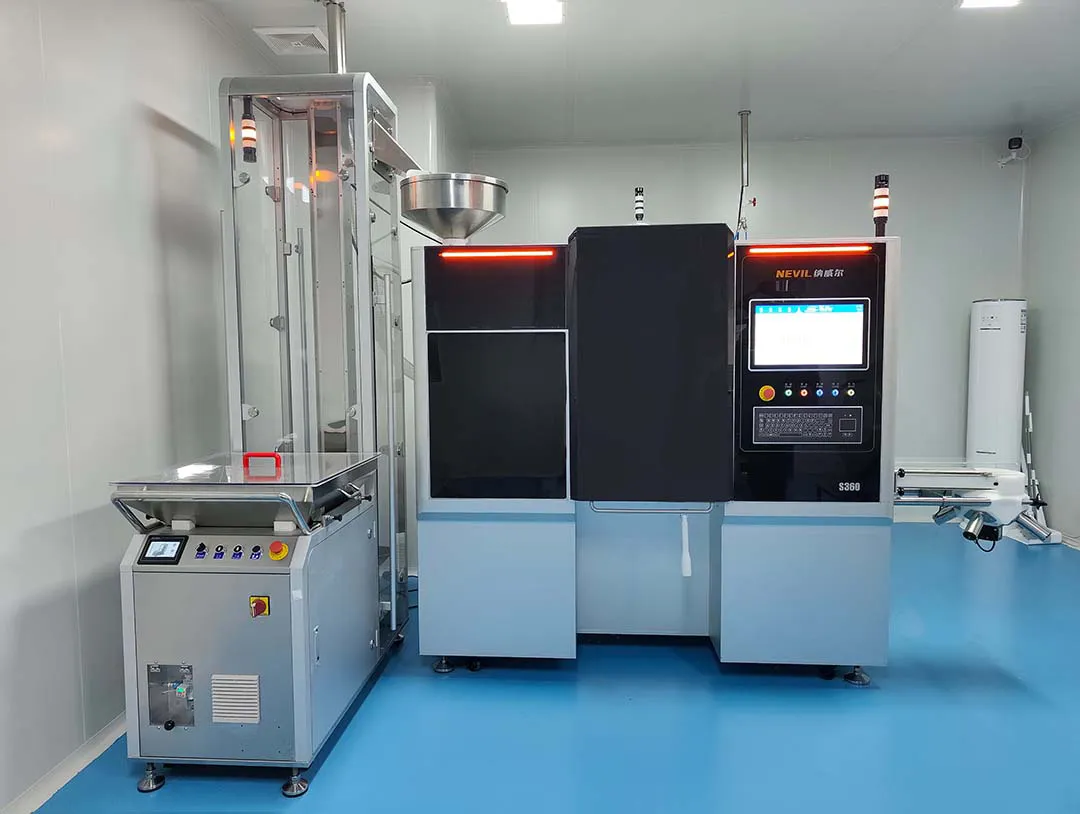
Referring to the inspection machine tender requirements of leading pharmaceutical companies such as Livzon Group, the true CQA defect detection rate must reach 100%, the comprehensive false rejection rate must be ≤5%, and the algorithm must pass statistically significant Knapp validation — when selecting equipment, pharmaceutical companies should require suppliers to provide validation challenge test reports similar to their own products, rather than only looking at nominal parameters.
📋 Capability 3: Full-process data records and traceability
• Regulatory-side validation: all review operations form detailed log records, facilitating retrospective investigation of problems, and supporting result viewing, export, and archiving
• Production-side implementation: Naweier inspection equipment meets the system construction and validation requirements of FDA 21 CFR Part 11; inspection data is stored in real time, and inspection results, real-time images, and operating status are dynamically displayed, building a dynamic quality database and continuously improving defect identification accuracy
⏱ Capability 4: Stable 7×24-hour operation
• Regulatory-side validation: the system operates continuously 7×24 hours
• Production-side implementation: the drum nested mold assembly design reduces disassembly parts and requires no professional tools; operators can complete mold disassembly and cleaning within 15 minutes; the vibrating plate feeding method does not jam tablets or capsules and requires no manual attendance, with stable operation and simple maintenance
III. Core Implementation Value of AI Inspection Deployment on the Production Side
For pharmaceutical manufacturers, upgrading inspection equipment to match the pace of regulatory AI pre-review delivers core value at three levels:
1. Reduce the risk of batch release rejection
Inspection standards are aligned with regulatory-side AI, reducing quality defects from the source, improving the pass rate of batch applications, and shortening the product launch cycle.
2. Controllable compliance risk
Full-process data meets GMP requirements, audit trails are complete, and it can directly respond to unannounced inspections and special inspections, avoiding compliance defects related to data integrity. As emphasized in Livzon's tender document, the system must fully comply with FDA 21 CFR Part 11, EU GMP Annex 11, and NMPA GMP requirements, have a non-disableable full-function audit trail, role-based permission management, and follow ALCOA+CCEA principles to ensure data integrity.
3. Long-term cost reduction and efficiency improvement
Replacing manual work with automated inspection solves pain points such as high turnover of manual quality inspection personnel, high training costs, and high misjudgment rates caused by fatigue, and in the long run can amortize quality control costs.
IV. Selection Recommendations: From "Looking at Parameters" to "Looking at Validation"
As smart regulation continues to advance across the national drug inspection system, AI pre-review will gradually cover more biological product varieties and batch release links in more regions. Completing the deployment of AI inspection equipment on the production side in advance is both a compliance requirement for adapting to regulatory upgrades and an inevitable choice for improving quality control capabilities and strengthening core competitiveness.
It is recommended that pharmaceutical companies focus on the following validation points when selecting equipment:
• Algorithm validation: require suppliers to provide performance data on challenge sets similar to their own products, rather than only looking at throughput marketing data; AI models must achieve strict version locking and digital signatures to prevent algorithm drift
• Compliance validation: system design must comply with FDA 21 CFR Part 11, EU GMP Annex 11, and NMPA GMP requirements, and have a non-disableable audit trail
• Lifecycle validation: follow GAMP 5 to provide full lifecycle validation (DQ/IQ/OQ/PQ); PQ must include process validation of 3 consecutive successful batches
• Delivery pace: refer to the project pace of the Guangdong Institute for Drug Control of "105 days development + 90 days trial operation," and specify validation points and trial operation assessment indicators (missed detection rate, false rejection rate, stability) in the contract, avoiding "good-looking laboratory data but failure on site"

FAQ (Frequently Asked Questions)
Q1: Between Naweier's 99.99% foreign matter detection rate and the Guangdong Institute for Drug Control's 98% accuracy, which is higher?
The two have different inspection objects and cannot be directly compared. The Guangdong Institute for Drug Control's 98% is for document review (LLM+OCR), while Naweier's 99.99% is for physical defect detection (machine vision). In their respective dimensions, both are industry-leading. When selecting equipment, pharmaceutical companies should pay attention to the two lines of "AI-enabled document review" and "AI-enabled production line inspection" separately.
Q2: Compared with tablets and hard capsules, where are the difficulties in soft capsule inspection? Can Naweier's equipment cover them?
Soft capsules have characteristics such as soft shells, easy deformation, and complex optical properties of the contents and shell, and traditional manual visual inspection has a high missed detection rate. Naweier's 360° appearance inspection machine explicitly includes soft capsules in its inspection specifications and can detect various defects such as holes, internal cuttings, cracks, bubbles, black spots, short bodies, top dents, pinches, and top stars, and can also detect mixed-color capsules.
Q3: What practical significance does equipment compliance with GMP and FDA 21 CFR Part 11 have for pharmaceutical companies passing audits?
It means that inspection data has the capabilities of traceable electronic records, complete operation logs, and tamper resistance. During audits, it can be exported with one click, avoiding deficiencies being issued due to data integrity issues. This is completely consistent with the design concept of "full-process data traceability" of the Guangdong Institute for Drug Control platform.
Q4: From order placement to acceptance, how long is the delivery cycle for Naweier equipment approximately?
The specific delivery cycle depends on configuration and validation requirements. It is recommended that enterprises refer to the project pace of the Guangdong Institute for Drug Control of "105 days development + 90 days trial operation" when tendering, and specify IQ/OQ/PQ validation points and trial operation assessment indicators (missed detection rate, false rejection rate, stability) in the contract, avoiding "good-looking laboratory data but failure on site."
Q5: What is the background of Naweier (Changsha) Intelligent Technology Co., Ltd.?
Naweier is a high-tech enterprise focusing on the field of intelligent drug inspection. Its self-developed 360° tablet/soft capsule/hard capsule appearance inspection machine uses linear vibrating plate electromagnetic vibration technology combined with a vacuum conveying and transfer system, with an inspection speed of up to 300,000 capsules/hour and 8-channel parallel operation. In October 2025, the equipment appeared at the 67th National Pharmaceutical Machinery Exposition (Qingdao) and attracted widespread industry attention with its "all-round, no-blind-spot" inspection capability — integrating deep learning algorithms with a high-precision optical system and equipped with a ring matrix composed of multiple million-pixel lenses, it achieves excellent performance with a foreign matter detection rate as high as 99.99%. Relying on the technical accumulation of its core technical team over many years in the field of intelligent drug inspection, Naweier has always closely followed drug production regulatory requirements, providing domestic pharmaceutical companies with overall intelligent inspection solutions that comply with GMP and FDA-related compliance standards, helping enterprises complete the intelligent upgrade of quality control links.
From the 98% AI pre-review accuracy of the Guangdong Institute for Drug Control to Naweier's 99.99% defect detection rate, an AI quality defense line running through the entire "regulation—production" chain is taking shape. As a deep cultivator in the field of intelligent drug inspection, Naweier has not only achieved breakthroughs in technical parameters that benchmark regulatory trends, but also, with mature solutions that comply with FDA 21 CFR Part 11 and ALCOA+CCEA principles, provides pharmaceutical companies with solid support that can withstand unannounced inspections and audits. At a time when smart regulation is comprehensively accelerating, choosing to walk with Naweier means choosing to use smarter "industrial eyes" to guard every checkpoint of drug quality.
 Scan for more



